Research of Writing
This was the final project for Theories of Writing. The purpose of this assignment was to conduct a research study on some writing related topic for an academic audience interested in the topic you select. This was to be question driven, rather than thesis driven, and we wrote a report on our findings. I was writing this paper right as this COVID-19 crisis was beginning, so I thought it would be really relevant and interesting to write about social media as an outbreak communication platform.
Social Media’s Effect: An Outbreak Communication Platform
With the corona virus crisis being such a relevant health issue in our society right now, people’s every-day activities, nation-wide sports and education, health, and the economy as a whole are just a few of the sectors that are greatly affected by this pandemic. Will our economy tank? Will our health system be able to sustain the burden of this virus? When will we be able to resume out every-day activities? These are questions that remain unanswered, and they instill fear in individuals worldwide.
The United States, a powerhouse worldwide, and critically acclaimed to be “untouchable”, is now humbled before this virus, as it sweeps America at great speed along-side countries worldwide. This seems to be one of the biggest tribulations the United States has seen in a long time. Policy makers seem to be panicking for solutions just as much as individuals are panicking about their health. Further, in the midst of this health turmoil, we must keep in mind we are in the middle of an election, placing added stress and unknown motivations on leaders in our government. As a country, we are still figuring out our priorities. As a democratic nation, we are not necessarily allowed to mandate and enact quarantines in the same way that communist countries in other parts of the world are able to.
It is important to look at an issue like this with a biosocial lens. A biosocial approach suggests that such biologic and clinical processes are inflected by society, political economy, history, and culture and are understood as interactions of biological and social processes. This in turn demands the reconciliation and sometimes the disruption of many frames of knowledge.
As a student and an athlete, I have a unique view on this issue. As of late, obviously schools have shut down, sports have been cancelled for the season, students have been asked to leave campus to go home, people are not allowed to gather into crowds, and travel has been restricted in many areas. It feels as if our country is essentially going into severe lockdown. My initial response was anger: I was angry that my senior lacrosse season that I have been working towards was getting cut short, I have to go back to my hometown and finish out my last quarter from my house with no contact with friends that I have spent 4 years with, and I have the financial burden of paying for seven months of rent in a house on campus that I am no longer able to live in. Another initial thought for me was that this was all a big overreaction. It didn’t help that our very own president was undermining the issue about by tweeting “So last year 37,000 Americans died from the common Flu. It averages between 27,000 and 70,000 per year. Nothing is shut down, life & the economy go on. At this moment there are 546 confirmed cases of CoronaVirus, with 22 deaths. Think about that!”. This tweet was right when everything started to blow up. With this declaration from our nation’s leader, people, including myself, felt as if they did not need to worry. Lo and behold, things spun out of control and now our country is shutting down.
I. Literature Review
This subject is incredibly interesting because pandemics are not very common in this age of extremely developed technology, science, and medicine. “The word pandemic comes from the Greek pandemos meaning ‘pertaining to all people.’ The Greek word pan means ‘all’ and the Greek word demos means ‘people’ (Brazier, 2018, pp. 3)”. A disease must be extremely powerful and dangerous to spread across such a wide geographical area and affect so many people. However, this must be somewhat attributable to the development of technology and the increased ease and ability to travel. Sickness does not discriminate by race, ethnicity, or income.
In addressing health issues for the mass consumption of the population, it is an interesting type of rhetoric. With a pandemic, health professionals and policy makers want the public to be informed. The fact of the matter is that the majority of the population as a whole will not sit down and read an intensive scientific journal or a comprehensive technical scholarly source on the ins and the outs of a virus. This is why rhetoric is such an essential part of containing this issue and educating people so that they can stay safe. How can literature be used to reach the masses in a consistent and easy way? This is really important because people are lazy. However, people need to be informed about this for their own well-being. This is why communicating disease outbreak is an essential aspect of disease control.
Following the SARS outbreak in 2002, the World Health Organization developed the WHO Outbreak Communications Guidelines. “These Guidelines stipulated that all acute public health event communications should be planned, organized and executed in keeping with the 5 principles: trust, transparency, announcing early, listening and planning” (Hartl, 2013, p. 27). The WHO explains that the art of communicating quickly and effectively is essential to dealing with outbreaks, trust being the key factor. “The first goal, therefore, of any and all communications during an acute public health event must be to build and retain trust, for only when audiences trust the communicator, will they listen to and take the protective public health actions which the public health spokesperson is recommending” (Hartl, 2013, p. 27).
Outbreak Communication guidelines have been revised over and over, lessons being learned from every new outbreak on how to best communicate. “The influenza pandemic of 2009 revealed shortcomings in the existing guidelines for risk and outbreak communication. Concepts such as building trust proved hard to achieve in practice, whereas other issues such as communicating through the internet and coping with the political fallout of disease outbreaks are not dealt with in existing guidelines” (Abraham, 2011, p.1). The Emerging Health Threats Journal outlines the need for new tools risk and outbreak communication and explains how communicators must be able to integrate risk and emergency with the health communication, understand and effectively use the internet, create trust in a post trust society, and be conscious of the political, social, and economic environment. (Abraham, 2011). Learning from past experiences and events should greatly inform future actions and policy towards issues such as these.
Social media plays a large role in outbreak communication, as social media is the language of the new generation and is the primary platform for many people to receive news and information. The WHO understands this and has facilitates social media as a platform for their communication with the public. “Social media, Twitter in particular, have become the main means for WHO to get news out quickly” (Hartl, 2013, p. 27). This social media presence began with the 2009 influenza pandemic when the WHO would tweet out updates and increases in daily case numbers, which was news that the population could absolutely rely upon. However, this was the WHO’s initial experience on the social media platform, and they then realized after the 2009 influenza outbreak that they needed substantial strengthening in this area.
Social media has transformed and developed the production, distribution and discovery of news. In a journal published by the Reuters Institute for the Study of Journalism at the University of Oxford, the author writes about how “The rise of global social networks is accelerating the trend towards an always-on interconnected world, where social discovery and social distribution are playing an even bigger role” (Newman, 2011, p. 6). Newman raises concerns about how social media poses a threat to news organizations because users’ interaction with social media sites for information reduces actual visits to news sites themselves. People are more inclined to “snack on headlines” than read full news articles (Newman, 2011, p. 20). It is really critical to understand people’s propensities with regards to consuming information about news and information in general to be able to decide how to expel information on important topics such as a pandemic.
At the end of his study, Newman concludes, “Social media behaves as a selective amplifier for the content generated by traditional media, with chains of retweets by many users leading to the observed trends. It goes on to suggest that, far from being an alternative source of news, social media acts more as a filter and an amplifier for interesting news from traditional media” (Newman, 2011, p. 28-30).
The WHO and UNICEF understand the impact of the delivery of information and its role in communication for behavioral impact, with specific regard to informing large groups of people in emergent situations, such as this corona virus outbreak. The WHO has created a toolkit for this, and the message it carries it very important. “Effective, strategically applied communication is therefore critical to address the behavioural and social aspects of disease prevention and control” (WHO, 2012, p. 1). This toolkit is designed for people designing more effective outbreak response measures. It can be scaled to tailor any situation at any level, from a behavioral and social perspective. This toolkit describes how in risk situations, “The objectives are to instill and maintain the public’s trust in the local and national health system and to convey realistic expectations about the capacity to respond and manage an outbreak” (WHO, 2012, p. 4). Focusing on behavior is in interesting route to take in situations such as these. However, “Disease outbreaks can have huge economic costs and equally devastating social costs. Understanding of behaviour and society can help to find effective ways for mitigating, preventing and controlling disease emergence and transmission” (WHO, 2012, 5). This journal explains that human behavior is the common denominator for epidemic risk, and ultimately prevention and control, because the choices people make on an individual level have a tremendous impact on outbreak control.
Through researching this topic, there is substantial information presented thus far on outbreak communication, and how social media is an integral part of communicating with the masses about important information. Additionally, there is sufficient evidence found for how communication must be geared towards behavioral and social aspects, as human choices can be key in success or failure of a disease suppression program.
What lacks in this research is how people actually respond to outbreak communication, especially through social media. Social media seems to be the primary communicating platform for important news and even emergency messages, so how does this affect people on an individual level? More specifically, this study will be conducted to observe college-aged people’s response to outbreak communication through social media. This study will measure how successful social media is at creating awareness around the corona virus, and how this influences attitudes towards the pandemic as a whole.
II. Introduction
In a national state of emergency, such as the current COVID-19 pandemic, citizens naturally are in a panic mode. In the midst of such panic, diverse attitudes, and inconsistent information, it is the elected officials’ duty to be transparent about current conditions of a country, and inform the population in order to successfully implement policy that can be implemented to deal with the issue at hand. It is the government’s duty to be consistent, truthful, and make decisions that keep everyone safe. Part of this is communication. How can information best be distributed to the masses? How can urgent information be communicated in a quick and emergent way that balances the emergency of the situation while also establishing trust and keeping people calm? This is something that in a time like this, with a deadly disease sweeping America among other countries, that these questions are relevant.
In this technologically dependent age, social media plays a large role in news broadcasting and information sharing in general. According to the WHO, “Good outbreak communications practices in and outside of acute public health events make communications a more effective public health tool” (Hartl, 2013, p. 29). In order to effectively communicate with its citizens, a country must know how to do so. The prevalence of social media in the current society is relevant because this has become the primary route of delivery for information. It has been concluded that “Social media behaves as a selective amplifier for the content generated by traditional media, with chains of retweets by many users leading to the observed trends. It goes on to suggest that, far from being an alternative source of news, social media acts more as a filter and an amplifier for interesting news from traditional media” (Newman, 2011, p. 28-30).
In this study, I am interested in finding out how effective social media is at generating awareness, and further, how outbreak communication through social media influences people’s perceptions on the COVID-19 virus. Additionally, since social media is generally aimed at presenting snapshots of information, how much does the presence on social media compel people to conduct research on the subject on their own.
I can only make predictions based off of my own experiences. At the beginning of the spread of the virus, I had the perception that this would be something that I did not need to be worried about, when the early news came out that you were basically only at risk if you were advanced in age or had respiratory issues. As a college student, I am in a position of being around many other young people, generating discussions around all of this current news. In this community of young healthy college students, the majority of people remained unphased as this health issue began to unfold. The most shocking part of all this was the accelerated timeline, and how things began to spin out of control exponentially in the matter of days. Perceptions began to change as talk of “coronavirus” became the most common topic to talk about, appearing in every conversation. When schools country-wide began shutting down, major league sports corporations cancelled seasons, and people were asked to not travel out of the country and highly advised to practice caution, this is when the conversation shifted into “maybe we should be worried now”. General panic started as people began questioning our government’s role in this and whether they are handling it correctly and no one could predict what would happen the next day.
As I have scrolled through my feed on multiple social media platforms, the memes, advisories, warnings, and information are overwhelming. The information on social media is coming at people in all sorts of ways: humor, intimidation, fear of the unknown and so on.
III. Methods
Research for this study presented very unique challenges for me. The first challenge was that when I planned my research, I intended to conduct interviews, collect surveys, and do observation on campus. Little did I know, everyone would be kicked off campus and everyone would be in a frenzy to get home.
With the madness that was going on, I had to shift to an online presence in research. The biggest challenge was that none of my interviewees responded to my email. Additionally, I got a very low response rate on my survey for students. This was understandable considering circumstances. This is naturally a challenge regarding current issue that is going on.
However, this did not deter me. I was able to analyze the small amount of data that I collected from college-aged students via survey-monkey. Survey-monkey was the method that I chose because I needed responses from people that could take the survey from home. I was able to send the survey to people to schools across the country, as to get some diverse responses.
Lastly, I had to supplement my feeble research with additional research online. I used results from my online survey to complement existing research done that could get me to where I could make more wholesome discoveries.
In order to eliminate biases, I sent this survey to both genders and of all ages in college. I also made sure to send this survey to people that did not just go to DU, but a variety of colleges in different regions in the country. Of course, I could not tell who actually took the survey, but I encouraged participants to pass the survey along to other candidates in the same fashion. It was in this way that I could create a diverse group of respondents.
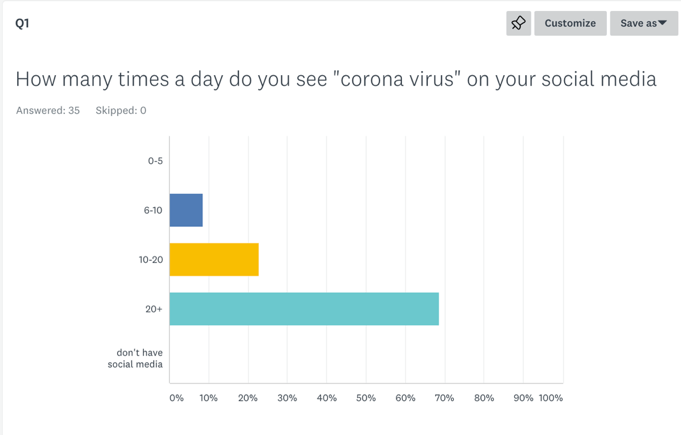
(See Exhibit A for survey Questions and results)
IV. Results
I received 35 responses to my questionaire on survey-monkey.
- My first question was: “How many times a day do you see “corona virus” on your social media”. 68.57% of respondents answered “20+ times”, 22.86% of respondents said 20-20 times, and 8.57% of respondents said 6-10 times. 0 respondents answered 0-5 times.
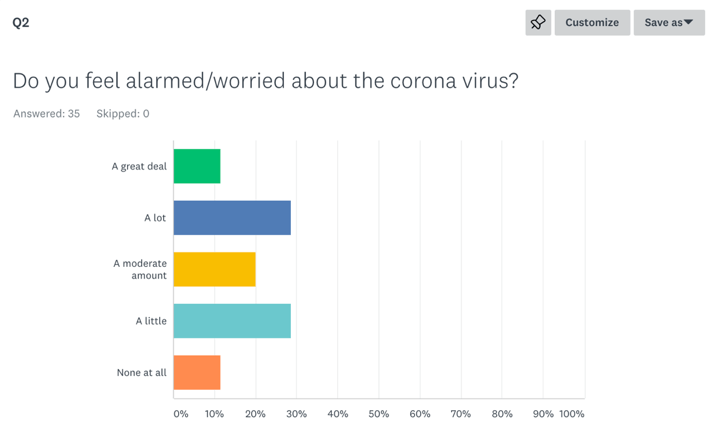
- My second question was: “Do you feel alarmed/worried about the corona virus?” The most popular response was tied between “a lot” and “a little” at 28.57% for each. The second biggest response (20%) was saying a moderate amount. Tied for the least responses at 11.43% was “a great deal” and “none at all”.
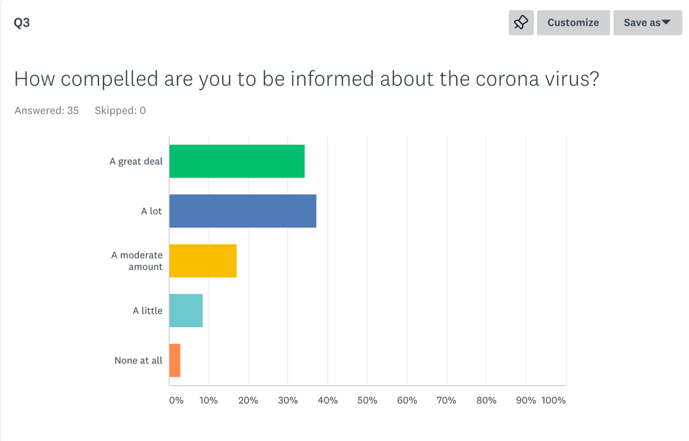
- My third question was: How compelled are you to be informed about the corona virus? Respondents seemed generally very compelled to learn more about the corona virus based on the responses to this question. 37.14% of respondents answered that they were compelled “a lot” to be more informed and 34.29% of respondents were compelled “a great deal”. 17.14% of respondents answered they were compelled to be informed a moderate amount, 8.57% answered “a little”, and only 2.68% (1 person) said “not at all”.
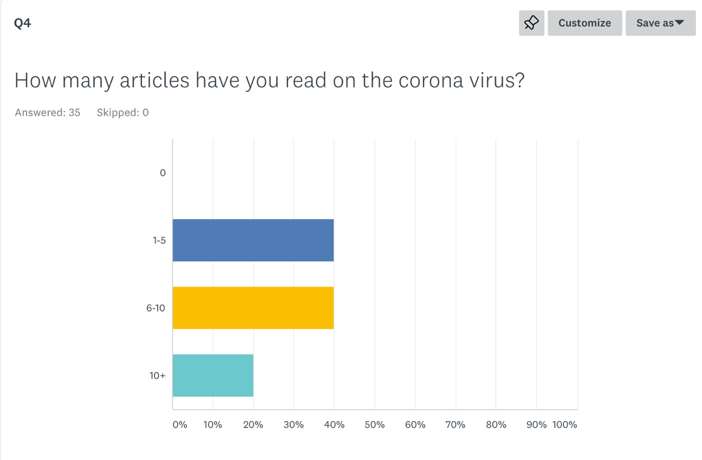
- My fourth question asked, “How many articles have you read on the corona virus?” Everyone that I surveyed had done research on their own because no one answered 0. Tied at 40%, was people answering “1-5” and “6-10”. 20% said more than 10 articles.
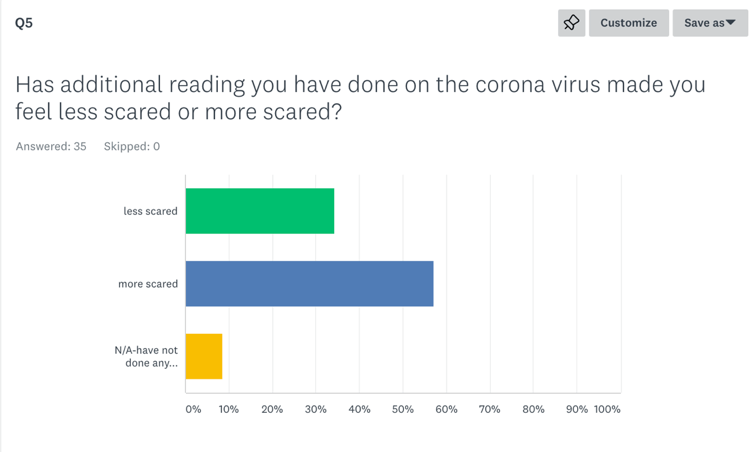
- My fifth question was, “Has additional reading you have done on the corona virus made you feel less scared or more scared?” The majority of people answered that additional reading made them more scared (57.14%). 34.29% of respondents said that they were less scared. 8.57% said this question did not apple, that they felt neither way.
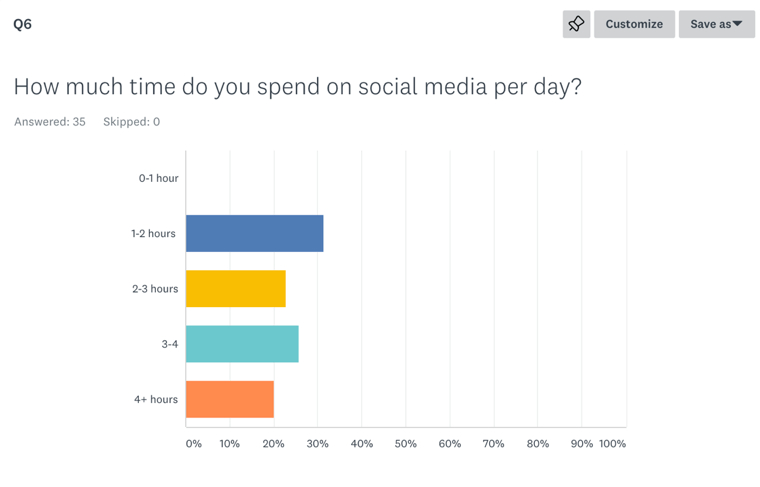
- My sixth question asked respondents, “How much time do you spend on social media per day. Most people answered that they spend 1-2 hours (31.43%). The next most popular answer was 3-4 hours (25.71%). 22.86% of respondents answered 3-4 hours, and 20% of respondents said 4+ hours. No respondents answered that they used 0-1 hour of social media.
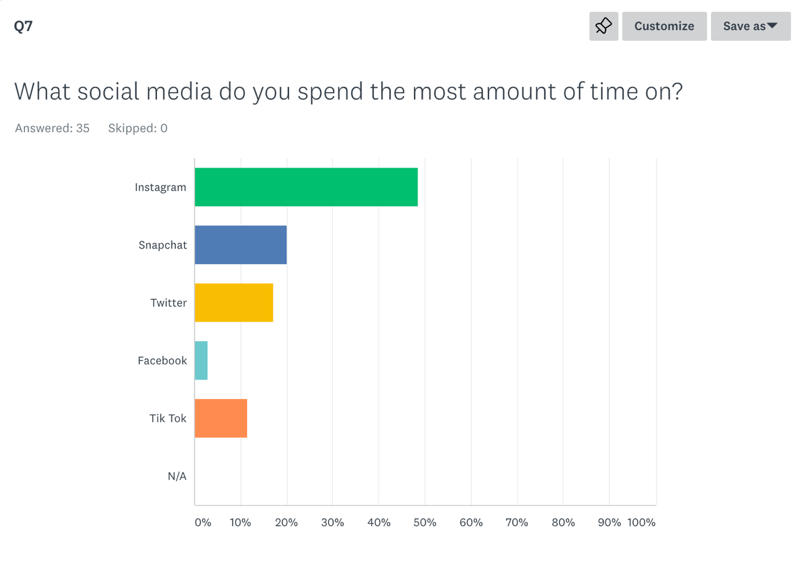
- My next question asked, “What social media do you spend the most amount of time on?” Instagram by far was the most popular, with 48.57%. Next was snapchat, with 20%, next was Twitter with 17.14%, next was Tik Tok, with 11.43%, and the minority (2.86%) chose Facebook.
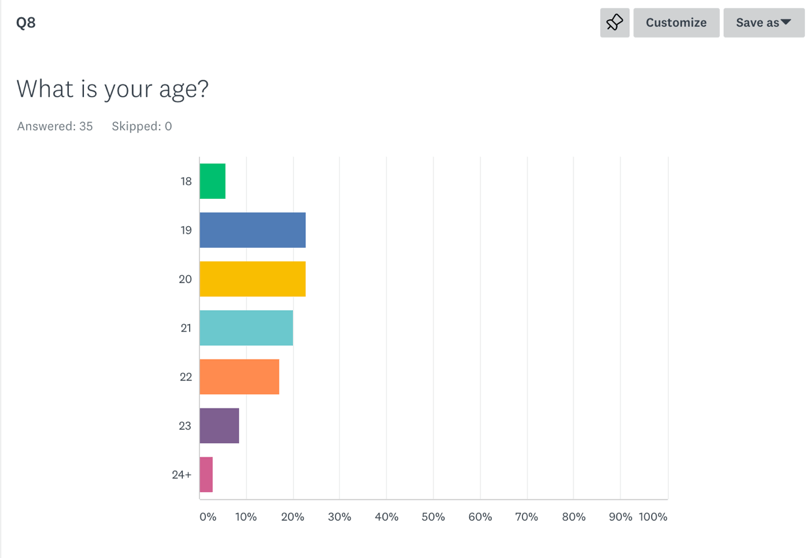
- The last question in this survey asked, “What is your age?” I only sent this survey out to college students because I wanted to get the opinions of college-aged students. The majority of people (22.86% each) were 19 or 20 years old. 20% were 21, 17.14% were 22, 8.57% were 23, 5.71% were 18, 2.86% were 24+.
V. Discussion
These data results complemented the research in a very interesting fashion. I asked people for their age to confirm that they are within my range for what I am analyzing. In analyzing college-aged people, I am able to assess the way in which the generation that is on the cusp of entering the workforce and those aged people that will be generating the ideas behind our country receives and processes information. Within this group, I was able to observe their propensities towards social media. It reaffirmed for me that social media is an important part of receiving information for this age range, as 100% of participants responded that they spent more than 1 hour on social media every day. Whether people realize it or not, they are absorbing information while they are scrolling through their feeds, and I can conclude from this that social media is how many young people are able to stay informed: socially, politically, environmentally, and economically. The main social media that people expressed the most use on was Instagram, which was nearly 50% of all respondents. This expresses to me that this age group may be more compelled to connect on a visual platform. Instagram is primarily geared towards visual elements, expressing news and other information in a concise way. This parallels my research from Mainstream Media and the Distribution of News in the Age of Social Media, which contributed that social media users are more inclined to snack on headlines than read full news articles. By receiving information via a platform such as Instagram, people are able to get information in a concise way that requires little to no effort in reading a journal or an article.
My data also showed that the majority of my respondents on my questionnaire said that they were very compelled to be more informed about the corona virus. Specifically, 72% of people who responded said they were either compelled “a lot” or “a great deal” to be more informed. It is also important to note that 69% of respondents answered that they saw corona virus mentioned on social media more than twenty times every day. This response indicates that not only are college-aged people very active on social media as a platform to receive information, but are also being made very aware of this pandemic that is occurring, and this awareness is compelling many of these people to do additional resources to be more informed on this issue.
I am noticing a chain of events occur here. First, college aged students are very active on social media. This leads them to be very exposed to information about COVID-19. This awareness is then translating to these people doing additional research on COVID-19 outside of social media. Every single person that took they survey indicated that they did additional research on COVID-19 in order to be informed. Not only did people so research, but many people have done seemingly extensive research on the subject.
Something that was not made too clear to me based on this research was how social media influences people’s perceptions about the COVID-19 virus. It is a bit unclear as to whether social media and the awareness it generates regarding the virus creates more or less fear, and if people feel more or less alarmed about the virus with being exposed to so much information about it. As I have already mentioned with my own experience, as a young person, I am not as concerned with my health, as I have read more and more information regarding how this virus could potentially affect my young and healthy body. However, after seeing the presence this topic has on the internet right now, especially social media, I do find that I am more alarmed about this virus as a national issue, as I can see before my eyes the social and economic implications this has on the country as a whole. Responses were a bit scattered with the question of whether people felt more or less alarmed about the corona virus from seeing it on social media so much. However, the majority of my respondents said that after additional reading, they felt more scared about the corona virus. This indicates to me that just seeing information about this corona virus in small snippets on social media does not necessarily inform people but creates awareness. However, more people seemed more informed after doing additional reading, and this additional research seemed to make people feel more scared about what was happening.
VI. Conclusions
Based on this study, I have concluded that social media presents a very strong platform for the main purpose of raising awareness in regard to outbreak communication. It is an effective means to communicate with mass amounts of people in emergent situations, especially in college students due to the amount of exposure that these people have with this platform. These results suggest that social media not only is able to create awareness with this type of issue but can compel users to go on and do their own research on the subject to become more informed.
VII. Exhibits
A. Survey Questions and Responses
VIII. References
Abraham, Thomas. “Lessons from the Pandemic: The Need for New Tools for Risk and Outbreak Communication.” Emerging Health Threats Journal, vol. 4, no. 1, 2011, p. 7160., doi:10.3402/ehtj.v4i0.7160.
Brazier, Yvette. “Pandemics: Past, Present, and Future.” Medical News Today, MediLexicon International, 22 May 2018, www.medicalnewstoday.com/articles/148945.
Hartl, G. “Novel Coronavirus: the Challenge of Communicating about a Virus Which One Knows Little About.” Eastern Mediterranean Health Journal, vol. 19, no. Supp. 1, Jan. 2013, doi:10.26719/2013.19.supp1.s26.
Newman, Nic. Mainstream Media and the Distribution of News in the Age of Social Media. Reuters Institute for the Study of Journalism, Department of Politics and International Relations, University of Oxford, 2011.
World Health Organization. Communication for behavioural impact (COMBI): A toolkit for behavioural and social communication in outbreak response. No. WHO/HSE/GCR/2012.13. World Health Organization, 2012.
 Laura's Writing Portfolio